



When It's Not Just Burnout: How High-Functioning Executives Actually Recover
When It’s Not Just Burnout: How High-Functioning Executives Actually Recover
From the outside, nothing looks wrong. You are still delivering. The team still gets what they need from you, the numbers still get hit, and no one watching would reach for a word like burnout, because you are far too capable for that, and too clearly on top of things.
Inside of you, it is a different picture. You are not sleeping properly. There is a brain fog that doesn’t lift no matter how you organise the week. You catch yourself overreacting to something small, and then you wonder where that came from. Underneath it all, there is a recognition, the sense that you have been running on autopilot for a long time and you are no longer sure who is actually driving.
So you look for a name for your experience. Maybe it is corporate burnout. Maybe you are sliding into depression. Maybe this is what mental decline feels like. You have read the symptom lists, and none of the usual fixes have had lasting effects.
Usually there is a layer underneath that off-feeling which those lists do not reach. High-performing leaders are rarely running on empty; they are running on overfull. Years of demands, responsibility, and taking care of everyone else have left you with almost no time or space to process any of it. You haven’t stopped feeling; you have simply gotten very good at suppressing what you feel, to the point where it now registers as flat, or grey, or just plain tired.
And the exhaustion is rarely spread evenly across your life. You might be the leader your people genuinely respect, and come home the same evening to arguments, distance, and a relationship you can’t seem to get right. You perform in one area and quietly decline in another. When you try to say how you are really doing, it tends to backfire, coming out as blame or as one more demand, until the conversation becomes a fight. So you stop. You carry it alone because everyone around you is convinced you have it all together.
One client said it plainly: he always believed that once he reached the level of success he now had, he would finally be at ease. He got there. He wasn’t. That isn’t failure, but rather one of the most common things we hear.
None of this means the physical side isn’t real. The sleep loss, the stress, and the sheer volume of what you carry are real and they matter. But if a good holiday and better habits were going to fix this, they already would have. What you are calling burnout is often emotional exhaustion, representing the cost of years spent disconnected from yourself, moving forward on autopilot with no room to feel what was building underneath.
Key Takeaways:
- What looks like burnout in high-functioning people is often emotional exhaustion — the cost of years spent disconnected from yourself, not only physical depletion.
- Rest, holidays, and better habits address the physical layer, but rarely reach the underlying patterns of self-neglect and eroded boundaries.
- Understanding your patterns intellectually doesn’t change them; lasting shift comes through body-based, somatic, and psycho-emotional work.
- An intensive, one-to-one executive burnout retreat offers seven uninterrupted days of full attention and privacy to reach what daily life keeps interrupting.
- Executive burnout recovery is less about fixing a problem than reconnecting with yourself, rebuilding self-trust, and finding a direction worth moving toward.
- Seven days creates the major shifts; integration continues afterward, often with follow-up coaching or therapy online.

Why Executives Don’t Recover From Burnout on Rest Alone
By the time someone reaches us, they’ve almost always already tried to help themselves. That’s the reflex of a high-functioning person: spot the problem, apply discipline, solve it.
So you take a bit more care. You book a short holiday. You sleep better for a week, get the bloodwork done, start the supplements, maybe do a mindfulness course. And sometimes it works, at least for some time. Then the company needs you, the obligations stack back up, and the same question returns: how am I ever supposed to actually take care of myself when everything else is always first on the list?
The vitamin D and the better sleep aren’t wrong. They’re essential, and for a classic burnout, where the body is genuinely depleted and the fatigue is heavy, that layer matters enormously. But it isn’t the solution for what’s usually underneath: years of self-neglect, eroded self-trust, overfunctioning that you’ve spent a long time overriding, and vulnerabilities that never got a chance to be felt. Those are the deeper core of a person. Address only the physiology and the essential layer stays missing.
There’s a second reason the usual fixes miss, and it catches thoughtful people off guard. Most of the executives we work with are already highly self-aware. They’ve often done some therapy. They can reflect on their patterns with real precision, name exactly what they do and why, and still can’t shift chronic stress. That’s not a failure of insight. It’s that understanding a pattern intellectually doesn’t change the pattern. The rational grasp of why you are the way you are lives in a different place from where the pattern actually runs.
Which is why more of the same won’t do it, meaning more willpower, more discipline, more action. Action has its place, and it follows later. But the deeper layers don’t respond to force or pondering; they respond to being reached differently, through the body, through somatic and psycho-emotional work, in a setting where there’s finally enough time and safety to feel what’s been held down for years.
And there’s one more thing the productivity approach skips entirely: learning to read your own states. What you’re calling burnout or depression is, in part, a state, and one you can unknowingly feed. Most people have been ignoring the early signals for a very long time. They feel the symptom once it’s arrived, but not the moment they started drifting toward it. Recognising that moment, catching yourself sliding toward the danger zone before you’re in it, is a large part of the actual work, and it’s not something a weekend holiday teaches you.
Beneath the Exhaustion — The Emotional Patterns Driving Executive Burnout
If it is not only burnout, what is it?
Under the exhaustion, the pattern we see again and again is a disconnection from oneself. Years of self-neglect and self-denial, combined with a heavy workload, lead to a slow erosion of self-trust, until you are no longer really in contact with your own inner world. This happens partly because some of what is in there is too painful to feel. So you do not feel it. You push through. And pushing through, for a lot of people, is exactly what built the success: the ability to override yourself and keep delivering.
That override usually started somewhere. It does not have to mean profound trauma sitting in the back seat, but often there is a moment the pattern started. A childhood experience. A relationship that broke. A dear person you lost. One of those moments where you make a decision about yourself that is not true, but you needed to make it at the time because you had to survive the painful situation. A personality gets built on top of that decision, driven by perfectionism, making you high-achieving, high-functioning, and always fine. It works for years. It works right up until the point it stops working, which is usually around when people find us.
You will also notice it in how hard it is to simply hold yourself. When these clients do open up, it tends to spill into oversharing, pulling others into the intensity, or turning vulnerability into blame and demands. Chronic workplace stress often magnifies this dynamic, leading to a profound sense of isolation as you carry the burden alone. Containing oneself is a skill that needs to be learned. That is not a character flaw. It is what happens when a lot of feeling has been held down for a long time and finally finds a gap. Boundaries, holding, and being stable enough to carry your own weight without collapsing it onto someone else is where a lot of the real work sits.
And there is often a quieter loss on top of all of it, where the purpose of life has gone thin. What rewarded you for years, such as the building, the winning, and the outer success, stops rewarding you. You reach the thing you were sure would make you feel at ease, and you do not. You might ask yourself who you have become and what the next step is. That lostness, and the missing hope underneath it, is one of the most common things we hear. It is not the next ten to-dos you are missing, but rather a reason to move at all.
Why an Intensive, One-to-One Executive Burnout Retreat Works
Here is the practical problem with everything above: you can’t reach it while the company, the phone, and the obligations are still first on the list. There is never room. That is the honest reason the self-care attempts don’t hold, which often makes achieving a sustainable work-life balance feel impossible.
This is why the therapy retreat format does something a weekend or a holiday can’t. For seven days, you stop. You stop writing emails, stop being on the phone, stop checking. And that alone opens more than people expect, as the moment the noise drops, you start to feel yourself again, and things that had no room to surface finally do.
It is also why we work one-to-one, privately, rather than in a group. What we have been describing isn’t group material. It needs privacy, and it needs depth you can’t reach in a room full of strangers. Over your days here you have the full attention of two facilitators and, for once, of yourself, inside a structured program that goes step by step rather than leaving you to figure it out. While conventional approaches to corporate burnout often rely on basic stress management techniques, an intensive private retreat in the quiet of Mallorca isn’t a softer version of therapy stretched over months; it is a concentrated, protected space to do in days what ordinary life keeps interrupting.
Executive Burnout Recovery: Inside the One-to-One Work
The point of the seven days isn’t to relax you. It’s to get to the root.
Step by step, the structured program helps you release the tension you’ve been holding, clear the emotional confusion and the mental clutter, and let the nervous system come down out of the state it’s been stuck in. As that settles, something opens. You’re in a safe space, safe enough to finally feel what you’ve spent years protecting from being seen. Most of these clients carry so much responsibility that they can never afford to fall apart; here, for the first time, there’s a place where it’s allowed. Not full breakdowns, but breakthroughs. Breaking open, and letting what’s been hidden come up.
And this happens through felt experiences, not analysis. You already understand yourself well; understanding was never the missing piece. So we work through the body, through somatics, and through deeper psychotherapy and trauma-informed processing at our mental health retreat in Spain, which reaches the levels that intellect can’t touch on its own. That’s what actually moves a pattern instead of just naming it.
Across the days, a few things happen together. You clear out what isn’t yours to carry anymore, shedding the unnecessary weight that makes delegation feel impossible and sustainable leadership out of reach. You begin repairing your relationship with yourself, and often with the people you’ve lost contact with, while building the genuine resilience needed for whatever comes next. There’s forgiveness in it, for others and for yourself. And there’s a turn toward what’s ahead: what do you actually want, and what’s the vision worth moving for? Underneath all of it, you’re building the capacity to hold yourself, containing even the neglected parts, so that when action comes, it comes from who you actually are rather than the personality you built to survive.
None of this happens in a vacuum. It’s held by two practitioners working together, combining therapeutic and depth work alongside bodywork, to support both the mind and the physical self inside a calm space and real nature immersion. That environment isn’t decoration. It’s the condition a person needs to actually heal and realign.

One-to-one session in Mallorca — an intensive executive burnout retreat offers full private attention
What Recovery Realistically Looks Like Afterward
We won’t pretend seven days solves everything, because it doesn’t.
What honestly happens is that people go through something profound. Most describe it as one of the most beautiful experiences of their life, the first time in a long time they’ve felt seen and felt connected to themselves again. A lot of real healing takes place. But the big shifts are the beginning of integration, not the end of the work. What you leave with is the movement itself, a vision for what comes next, and a set of tools and guidelines to turn the insights into something tangible in ordinary life. Many people choose to continue with executive coaching afterward, which we usually do online, precisely to hold that integration as part of their ongoing burnout recovery.
The deepest result isn’t a fixed problem. It’s that you feel yourself again and trust yourself again, and you come away knowing that the only person who can truly do this is you. That’s not a defeat, it’s the commitment that changes things, and because you’ve now actually experienced it rather than imagined it, you know it’s real and possible. People leave saying they feel alive again, reborn. Not every problem is solved, but they’ve seen, first-hand, what becomes possible the moment they asked for help and started taking care of themselves.
Frequently Asked Questions About Executive Burnout Recovery
How do you recover from executive burnout when rest hasn’t worked?
Rest restores the body, but executive burnout is often driven by emotional exhaustion and years of self-neglect that rest alone doesn’t reach. Recovery at that level means working with the underlying patterns — through the body, the nervous system, and deeper emotional processing — not only sleeping more or taking a longer holiday. That’s usually why the reset from a break fades so quickly once ordinary demands return.
What’s the difference between burnout and emotional exhaustion?
Classic burnout shows up in the body — genuine physical depletion, often visible in bloodwork — and responds well to rest, recovery, and better habits. Emotional exhaustion sits underneath: the cost of carrying years of unprocessed feeling, responsibility, and disconnection from yourself. The two often overlap, which is why addressing only the physical side can leave the deeper exhaustion untouched.
How long does it take to recover from burnout?
There’s no fixed timeline, because it depends on how long the patterns have been building and how deep they run. An intensive week can create the major shifts — the openings, the reconnection, a clearer sense of direction — but integrating those changes into daily life continues over the months that follow. Many people pair the retreat with follow-up coaching or therapy to hold that integration.
Can I recover from burnout without stepping away from work completely?
Small adjustments alongside a full schedule can help at the margins, but they rarely hold, because the obligations always return to the top of the list. Part of what makes an intensive private retreat effective is that it removes the interruptions entirely for a set period, so there’s finally enough space to reach what’s underneath. For most executives, a concentrated pause does more than a scattered attempt to fit recovery around work.
Is an executive burnout retreat different from a wellness holiday?
A wellness holiday is designed to relax and refresh you; an executive burnout retreat is structured therapeutic and depth work with the goal of reaching the root of the exhaustion. The difference shows up in the format — one-to-one attention, a step-by-step program, and practitioners guiding the process rather than a schedule of activities. Understanding which one you actually need is worth a closer look at the different types of retreats before you choose.

If Something Here Felt Familiar

If you’ve read this far and something here felt familiar, that’s worth paying attention to. What you’ve been carrying has been asking for space you haven’t been able to give it — and sensing that is often the first honest step toward doing something about it.
Before deciding anything, it helps to understand what actually separates genuine depth work from a packaged getaway. Our free guide, The Honest Guide to Choosing a Retreat, walks you through exactly what to look for so you can choose well.
And if you’d rather talk it through, you can arrange a call with us directly — a quiet conversation, no pressure, to see whether this is the right fit. Prefer to write first? You can do that too.

Exploring Your Options?
Choosing the right retreat is a meaningful decision.
Our honest guide covers what to look for, what to ask — and what most retreat websites won’t tell you.
11 practical things worth knowing before you decide.
And if what you’ve read here resonates, you’re welcome to explore what we offer — or simply have a conversation about what might fit.


Retreats for Men: A Guide to Depth, Healing & Real Change [2026]
This guide maps the full landscape of men's retreats, helps you understand the real differences between formats, and gives you a framework…

Transpersonal Therapy: What It Is and Why It Goes Deeper
In this guide, you'll learn what transpersonal therapy actually is, where it comes from, how it differs from more familiar approaches, what…

Trauma Retreats: Who They’re For and How They Work
This guide explores what trauma actually is, who trauma retreats serve, and how the process works — so you can sense and recognise whether…

Therapy Retreats: What to Expect, Who They’re For, and How to Choose Well
You've probably been in therapy before — or you've considered it seriously. Weekly sessions have their place, and for many people they're…

Types of Retreats: A Guide to Finding the One That’s Right for You
Most people who start looking at retreats aren't in deep crisis. They're functioning — seen from the outside, often functioning quite well.…


Transpersonal Therapy: What It Is and Why It Goes Deeper
What Is Transpersonal Therapy? A Guide to the Work Beyond the Surface
At some point in life, the questions change.
You may have spent years building a life that works — a career, relationships, a sense of who you are in the world. And yet, underneath the competence and the daily momentum, something is asking for more. A deeper sense of meaning. A fuller relationship with yourself. The kind of fulfillment that can’t be reached through personality-level work or cognitive understanding alone.
This is where transpersonal therapy begins. It works with all of who you are — including the dimensions that conventional therapeutic approaches rarely touch: your deeper sense of Self, your longing for coherence, the parts of your experience that don’t fit neatly into diagnostic categories but matter profoundly to how you live.
Transpersonal therapy is rooted in depth psychology and decades of clinical practice. It’s a serious, grounded therapeutic modality — and for those at certain turning points in life, it may be the approach that finally reaches the depth they’ve been looking for.
In this guide, you’ll learn what transpersonal therapy actually is, where it comes from, how it differs from more familiar approaches, what a session looks like in practice, and how to recognise credible, rigorous work in this field.
Key Takeaways
- Transpersonal therapy works with all of who you are — including the dimensions of meaning, purpose, and deeper Self that conventional approaches often don’t reach
- It’s rooted in depth psychology (Jung, Maslow, Grof) and works with naturally expanded states of awareness — no substances, no hypnosis
- The approach is especially relevant when life asks deeper questions: fulfillment, grief, existential turning points, the longing to become more fully who you are
- A transpersonal session may include breathwork, guided inner work, or somatic approaches alongside deep reflective dialogue
- On a holistic retreat, the immersive setting allows this work to unfold with a continuity that weekly sessions rarely offer
- Credible transpersonal work is rigorous — watch for practitioners who promise quick fixes or rely heavily on mystical language
What Is Transpersonal Therapy?
Transpersonal therapy is an approach to therapeutic work that includes mind, body, and spirit — the deeper dimensions of human experience including meaning, purpose, identity, and the relationship to what some call the Self with a capital S. In the simplest terms: it works with all that makes you who you are, even the parts you don’t yet see, don’t fully understand, and may not have language for. Excluding those dimensions would mean losing the chance to become whole.
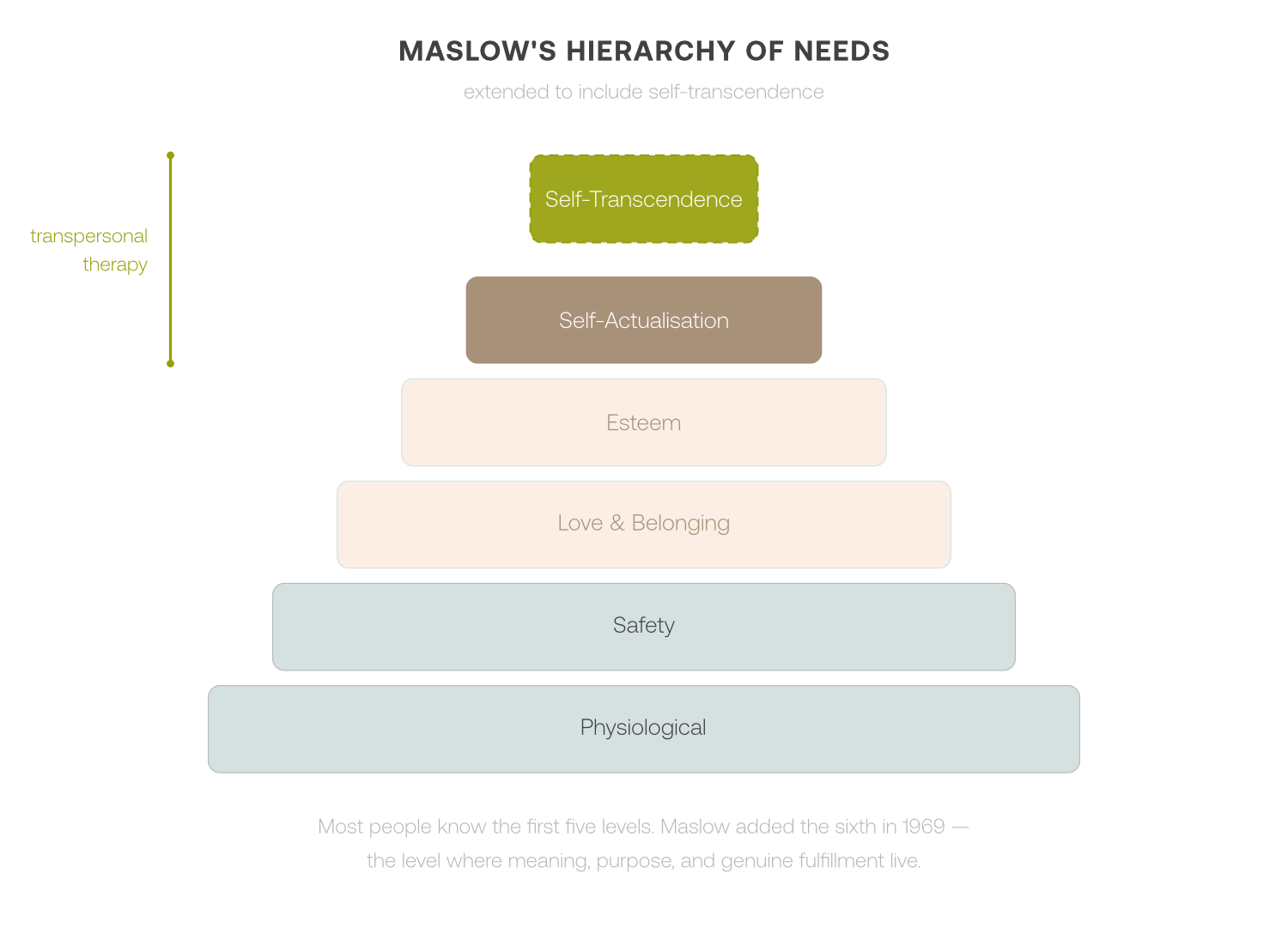
The roots of transpersonal therapy run through the work of Carl Jung, who understood that the psyche holds far more than personal biography. Abraham Maslow, known for his research on human development and his hierarchy of needs, eventually moved beyond self-actualisation toward what he called self-transcendence — recognising that the deepest human fulfillment involves connecting with something larger than the everyday personality. Stanislav Grof contributed pioneering work on expanded states of awareness — including holotropic breathwork — and their role in transpersonal healing. Together, these thinkers established transpersonal psychology as what Maslow described as a “fourth force” in the field — after psychoanalysis, behaviourism, and humanistic psychology.
More recently, Ken Wilber’s integral framework has mapped these developmental stages into a comprehensive model of human growth — what he calls the spectrum of consciousness — offering practitioners and those seeking depth work a clear orientation for where this work leads and what deeper levels of integration look like. Transpersonal theory continues to evolve, but its core insight remains: who you are extends beyond the boundaries of the ego, and genuine healing must account for that.
In practice, transpersonal therapy recognises that some of the most meaningful therapeutic work happens in naturally expanded states of awareness. These are states the body and mind enter on their own — alpha and theta brainwave states — when the conditions are right: when you feel safe, when the practitioner can hold the space with clarity, and when there’s enough time and trust for the deeper layers to surface. They allow access to material that ordinary conversation simply can’t reach. This is part of what gives transpersonal work its depth and its capacity to touch something that more structured approaches leave untouched.
The word “transpersonal” literally means “beyond the personal” — beyond the persona, the mask, the functional self you present to the world. Beyond the ego boundaries that define your everyday identity. That might sound abstract, but in lived experience it’s remarkably concrete. It’s the moment when someone who has spent decades defining themselves through achievement begins to sense that who they truly are runs far deeper than what they’ve built. It’s the recognition that lasting fulfillment, real meaning, genuine inner peace — these can rarely be found on the level of personality and cognitive knowledge alone.

How Transpersonal Therapy Differs from Other Therapeutic Approaches
If you’ve worked with other forms of therapy, you already know that different approaches focus on different layers of experience. Each has real value, and for many people the right modality at the right time makes an enormous difference.
Cognitive behavioural therapy works with thought patterns and learned behaviours. It’s effective at reducing symptoms — particularly anxiety, depression, and specific phobias — by helping you recognise and change the mental habits that maintain them. What it tends to address less is the deeper question of why those patterns formed in the first place, and what they may be expressing about your relationship to yourself and your life as a whole.
Psychodynamic and talk therapy goes deeper into the unconscious — childhood patterns, relational dynamics, the way early experience shapes how you connect with others and with yourself. This work can be profoundly important. Transpersonal therapy shares this interest in the unconscious, but extends the frame further. It includes the dimension of meaning, purpose, and the longing to integrate all of who you are — not only the parts shaped by biography, but also the parts that carry your deeper sense of direction and potential.
Somatic and body-based therapy recognises that the body holds experience — tension, trauma, emotion — and works to release and process what lives beneath conscious awareness. Transpersonal therapy often integrates somatic awareness, understanding the body as a gateway to deeper material. It places that body-level work within a larger frame of identity, meaning, and personal wholeness.
Humanistic therapy is the closest relative. Both value the whole person, both believe in your capacity for growth and self-actualisation. Transpersonal therapy extends this by engaging with the dimensions that Maslow himself eventually pointed toward: the deeper Self, the longing for integration, the parts of experience that go beyond self-improvement into genuine self-understanding.
A pattern that comes up often in practice: someone arrives having done years of good therapy. They’ve benefited genuinely — they understand their patterns, they’ve processed emotions, perhaps they’ve done bodywork too. And yet there’s a core layer that hasn’t been touched. The intellectual and emotional dimensions have been addressed, sometimes even the physical. But the level of the soul — of the deeper Self, the place where meaning lives — remains unexplored. Transpersonal therapy is designed to reach that level, carefully and with the right support.
What Happens in Transpersonal Therapy
The most meaningful transpersonal work happens when the practitioner has the capacity to fully allow your psychological reality into the room. Whatever you experience — images, sensations, memories, emotions, or material that doesn’t fit familiar categories — is met as real. Not analysed from the outside. Not reduced to a diagnosis. Jung called this the phenomenological approach: if you experience it, it is your reality, and the work is to make the unconscious conscious.
This requires deep experience on the practitioner’s side. The therapist’s role is to hold the space with clarity and precision — to allow whatever surfaces without losing direction or structure. You are not left alone with overwhelming material, and you are not steered toward a predetermined outcome. The practitioner guides, offers frameworks when they’re useful, and knows when to simply be present while something unfolds.
A session begins with conversation, but a different quality of conversation. The therapist listens for what’s trying to emerge, not for what’s wrong. If you say “I feel lost,” a transpersonal therapist hears the lostness — and also pays attention to what deeper wisdom the lostness is guiding you to. The language you use matters. If you speak about longing for something you can’t name, that longing is taken seriously as a signal from a deeper intelligence within you.
As trust deepens and the therapeutic container stabilises, naturally expanded states of awareness can emerge within a transpersonal therapy session. These aren’t dramatic or unsettling — they’re what happens when your body-mind settles into a depth where insight becomes available in a different way. The practitioner works with whatever surfaces in that space. Breathwork, guided inner work, reflective dialogue, or somatic approaches may all play a role, depending on what the moment calls for and what you’re ready for. This willingness to embrace and trust the emerging psychodynamic material is the foundation for very powerful transformation.
Techniques you may encounter in transpersonal therapy include transpersonal regression therapy — careful, guided exploration of past experiences that shape deep patterns of current life experience — as well as breathwork, meditation, guided imagery, dreamwork, and body-aware dialogue. Transpersonal somatic therapy bridges the body and the psyche, recognising that the two are inseparable in deep work.
Integration is essential. The depth work needs to land in your daily life. This is where transpersonal therapy needs bridging into more practical, coaching-based approaches — helping you translate insight into decisions, new ways of relating, and a more grounded sense of who you are and how you want to live. The profound and the practical belong together. Without integration, even the deepest experience remains an isolated event rather than a genuine shift.
Who Is Transpersonal Therapy For?
Transpersonal therapy tends to find the people who need it — often at a turning point they didn’t plan for.
You may be in the second half of life, having achieved much of what you set out to achieve, and discovering that success didn’t answer the deep questions that lead to inner fulfillment. A pattern we see regularly: someone arrives in their fifties, having built an impressive external life — career, financial security, perhaps recognition in their field. And underneath all of it, there’s depression, anxiety, a sense of being drained and disconnected from themselves. They’ve spent decades focused on the outer structure and neglected the inner Self. Not out of carelessness, but because no one ever gave them a framework for tending to that dimension.
When someone like this begins doing transpersonal work, what often emerges first is the sheer weight of unprocessed material — the emotions, the grief, the questions about meaning that were set aside for years because there was always something more urgent to handle. The functional personality that carried them through decades begins to soften, and something more alive starts to surface. It’s often described as feeling like coming home — not to a place, but to themselves.
Transpersonal therapy is also for you if you’re navigating grief, an existential crisis, a major life transition, or a period where the familiar structures of identity no longer hold. If you’re asking questions about meaning, fulfillment, purpose — and sensing that the answers live somewhere beyond the level of thinking.
You don’t need to consider yourself spiritual. You don’t need a belief system or a meditation practice. What helps is a willingness to acknowledge that who you are runs deeper than your roles, your history, and your habits of mind — and a readiness to explore what lives in that depth.
Why Transpersonal Therapy Goes Deeper on a Retreat
Transpersonal work asks something of you that most therapeutic formats struggle to accommodate: it asks for continuity.
In weekly sessions, you may touch something genuinely deep — a layer of emotion, a memory, a moment of insight that changes how you see yourself. And then the hour ends. You gather yourself, walk back into your day, and by the time you reach home or the office, the ordinary self has reassembled. Most people describe this experience clearly: they could feel themselves approaching something important, and then the session was over. They had to “have it all together” again before they’d even left the building.
A private retreat setting — for many people, for the first time in their lives — removes that constraint entirely. There’s no commute. No inbox. No one else’s needs to manage. The space holds you, and the work can unfold in its own rhythm: depth in the morning, integration in the afternoon, rest and reflection in between.
For transpersonal work specifically, this matters enormously. The expanded states of awareness that allow access to deeper material need time and safety. They don’t arrive on a schedule, and they can’t be rushed into a fifty-minute window. On retreat, the body relaxes enough to open, the mind quiets enough to listen, and the therapeutic relationship has the continuity to support whatever emerges — through a full arc of exploration and integration, rather than fragments spread across weeks.
The holistic approach of a transformative retreat — where body-based practices, therapeutic depth, and restorative space work together — opens you at every level simultaneously. Body, mind, and the deeper Self can be addressed as one. What might take months in weekly sessions can reach a meaningful depth in days, because the process is never interrupted.
This is why people leave retreat work feeling fundamentally different — lighter, more alive, more themselves. The weight lifts because the work was given the space it needed to actually complete.

What to Look For — and What to Watch For
When considering transpersonal therapy, the practitioner matters as much as the modality. Look for someone with genuine clinical experience and depth of training — someone who can hold space for your deeper material with clarity and skill, and who can bridge between the profound and the practical. The therapeutic relationship is the foundation. Without trust, safety, and a sense of being truly met, the deeper work simply can’t happen.
What to watch for:
- Spectacular promises or language that sounds more like marketing than therapeutic practice
- Heavy reliance on ritual, mystical tools, new age claims or “secret knowledge” as the method
- Any suggestion that you can bypass the real inner work — the grief, the difficult truths, the discomfort — through a shortcut or a quick technique
The most meaningful transpersonal work is rigorous. That’s worth knowing in advance, because it’s also what makes it trustworthy. The depth is where genuine transformation lives, and there are no fast lanes to get there. When a practitioner is honest about that, it’s one of the clearest signs you’re in the right place.
Frequently Asked Questions About Transpersonal Therapy
Is transpersonal therapy evidence-based?
The evidence base for transpersonal therapy is growing steadily. Research on mindfulness-based interventions, breathwork, and psychedelic-assisted therapy — all of which share roots with transpersonal approaches — has produced strong clinical results. Studies on transpersonal psychotherapy specifically, including work with cancer patients, have shown measurable benefits for depression, anxiety, and post-traumatic stress. The field continues to build its formal research base, while many of the individual techniques it draws from are already well-supported.
Do I need to be spiritual to benefit from transpersonal therapy?
No. You don’t need a spiritual practice, a belief system, or any particular worldview. Transpersonal therapy works with your direct experience — the deeper dimensions of who you are, your sense of meaning, your longing for coherence — regardless of how you frame those experiences philosophically. What helps is openness: a willingness to explore aspects of yourself that go beyond your usual way of thinking. Many people find that the work touches something they might describe as a spiritual experience, even if they’d never used that language before.
What’s the difference between transpersonal therapy and transpersonal psychology?
Transpersonal psychology is the academic field — the theory, research, and frameworks developed by thinkers like Jung, Maslow, and Grof. Transpersonal therapy is the applied practice: working one-to-one with a practitioner who uses those principles to support your healing and growth. Think of it as the difference between studying architecture and actually building a house.
How is transpersonal therapy different from spiritual counselling?
Spiritual counselling typically works within a specific religious or spiritual tradition and may involve guidance rooted in particular teachings or practices. Transpersonal therapy draws on depth psychology, somatic awareness, and the broader human experience of meaning-making. It doesn’t belong to any tradition and doesn’t require you to hold any particular beliefs. The focus is on your lived experience and your own path toward integration and wholeness.
Can transpersonal therapy help with trauma?
Yes. Transpersonal approaches are particularly relevant for trauma work because they address the impact of traumatic experience across multiple dimensions — emotional, somatic, energetic and existential. When trauma disrupts your sense of meaning, identity, or safety in the world, an approach that works only at the cognitive or even the emotional level may not reach deeply enough. If you’re interested in how trauma healing works in a retreat setting, our guide to trauma healing retreats explores this in depth.
Finding Your Path
Transpersonal therapy is, at its core, about becoming more fully who you are. It takes the whole of your experience seriously — the feelings that make sense and the ones that don’t yet, the questions that have clear answers and the ones that require a different kind of listening.
If this resonates, you may want to explore what this work looks like within an immersive retreat setting designed for deep therapeutic work. The depth that transpersonal therapy offers becomes available in a different way when the container holds, when there’s time, and when you’re supported through the full arc of the process.
Whatever your next step, the fact that you’re asking these questions is itself a sign. Something in you already knows there’s more.
If you’d like to explore whether a private therapy retreat at Casa Sol might be the right fit, we start with a 30-minute conversation. No pressure — just an honest first meeting. Book a Discovery Call →
For a broader view of how different types of retreats support different kinds of inner work, our complete guide is a good place to start.
Exploring Your Options?
Choosing the right retreat is a meaningful decision.
Our honest guide covers what to look for, what to ask — and what most retreat websites won’t tell you.
11 practical things worth knowing before you decide.
And if what you’ve read here resonates, you’re welcome to explore what we offer — or simply have a conversation about what might fit.
Retreats for Men: A Guide to Depth, Healing & Real Change [2026]
This guide maps the full landscape of men's retreats, helps you understand the real differences between formats, and gives you a framework…
Transpersonal Therapy: What It Is and Why It Goes Deeper
In this guide, you'll learn what transpersonal therapy actually is, where it comes from, how it differs from more familiar approaches, what…
Trauma Retreats: Who They’re For and How They Work
This guide explores what trauma actually is, who trauma retreats serve, and how the process works — so you can sense and recognise whether…
Therapy Retreats: What to Expect, Who They’re For, and How to Choose Well
You've probably been in therapy before — or you've considered it seriously. Weekly sessions have their place, and for many people they're…
Types of Retreats: A Guide to Finding the One That’s Right for You
Most people who start looking at retreats aren't in deep crisis. They're functioning — seen from the outside, often functioning quite well.…