


Retreats for Men: A Guide to Depth, Healing & Real Change [2026]
Retreats for Men: A Guide to Finding Depth, Healing, and Real Change
If you’ve been looking into retreats for men, you’ve probably noticed something: most of what’s out there falls into two camps. There are performance-focused retreats — cold plunges, peak-performance coaching, brotherhood circles, and a particular brand of “become the best version of yourself” energy. And there are religious retreats — faith-based weekends with prayer, scripture, and community.
Both of those serve real needs. But if neither feels like the right fit — if what you’re looking for is something quieter, more personal, and genuinely deep — the options get harder to find. A growing number of men are looking for exactly this: not a programme built around dogma or discipline, but a space where they can finally address what’s actually going on beneath the surface. A life transition. A relationship that’s unravelling. Years of running on autopilot. Grief they haven’t had time to process. The sense that something fundamental needs to change — even if they can’t fully name what.
This guide maps the full landscape of men’s retreats, helps you understand the real differences between formats, and gives you a framework for choosing the one that fits where you are right now.
Key Takeaways
- Most retreats for men fall into religious or performance categories — but a growing number of men are looking for psychological depth and personal healing instead.
- Around 80% of men attending depth-oriented retreats have never done a retreat before, and over 60% have no prior experience with therapy or coaching.
- The most meaningful differences between retreat types aren’t the activities — they’re the depth of facilitation, the qualifications of the practitioner, and whether the format gives you genuine privacy.
- A men’s wellness retreat built around therapy, somatic work, and life coaching can address what surface-level approaches miss: unprocessed grief, relationship patterns, self-neglect, and emotional weight carried for years.
- The best indicator of a quality retreat for men isn’t the marketing — it’s whether you feel genuinely met in the initial conversation.
Why More Men Are Seeking Retreats — And What They’re Not Finding
Something has shifted. More men are recognising that the way they’ve been managing everything — work, relationships, health, emotions — isn’t sustainable. Not because of a single crisis, but because the cumulative weight of years on autopilot is starting to show. Mental fatigue. Emotional distance. A nagging sense that despite external success, something essential has been neglected.
What’s striking is how many of these men aren’t coming from the “wellness world.” In depth-oriented retreat settings, roughly 80% of male participants have never done a retreat before. Over 60% have never worked with a therapist or coach. They’re not looking for another framework or philosophy. They’re looking for something they haven’t been able to find in their existing circles — including, often, their closest friendships and even men’s groups.
What draws them is usually a combination of two things: a clearly designed programme (not vague promises of transformation), and practitioners with credible, real-world experience. Men who’ve built companies, navigated corporate structures, or carried significant professional responsibility tend to look for someone who understands that world — not someone who’ll talk at them from a textbook or shouts at them to “open up and feel.” They want depth without the woo-woo. And what often surprises them is how much deeper the work goes than they expected.

Types of Retreats for Men — The Full Landscape
The label “men’s retreat” covers an enormous range of experiences. Understanding what’s actually out there — and what each format is designed to do — saves you from booking something that doesn’t match what you need.
Religious and Faith-Based Retreats
This is the largest category of retreats for men by volume on the market. Christian, Catholic, and other faith-based retreats typically run as group experiences over a weekend or a week, guided by clergy or spiritual leaders. The focus is prayer, scripture, communal reflection, and deepening one’s relationship with God. For men whose faith is central to their life, these can be profoundly meaningful. They offer spiritual community and a structured path for inner reflection within a shared belief system.
Adventure and Performance Retreats
This is the category that dominates social media. Think cold-water immersion, physical challenges, accountability coaching, biohacking protocols, and high-energy group environments. The framing tends toward optimisation: become stronger, sharper, more disciplined. Some include elements of men’s circles or vulnerability exercises, though typically within a competitive or achievement-oriented structure. For men with a clear physical or performance goal, these retreats deliver structured intensity and camaraderie.
Spiritual Retreats Without a Religious Framework
Worth mentioning separately: there’s a growing space between faith-based and performance retreats. A spiritual retreat for men might include meditation, breathwork, nature immersion, or contemplative practices without being tied to a specific religion. These vary widely in depth — some are genuinely transformative, others lean toward surface-level mindfulness experiences. The key question is always who’s facilitating and what their actual training is.
Therapy, Healing, and Depth Retreats
This is the category that’s hardest to find — and the one a growing number of men are looking for. Therapy retreats for men are built around genuine psychological work: depth psychology, trauma processing, somatic therapy, and guided life coaching. Rather than a group programme, these often operate in private or small-group formats with licensed therapists or experienced practitioners. The focus isn’t performance — it’s understanding. Understanding what’s been driving you, what patterns keep showing up, and what’s been carried for too long without attention.
A mental health retreat for men in this category might address depression, burnout, emotional weight, relationship difficulties, or the aftermath of major life transitions — not through medication management, but through intensive, personally guided therapeutic work that supports real emotional healing at its roots.
Private and 1:1 Retreats
The least-known format, and for many men, the most effective. A private retreat removes the group dynamic entirely. It’s you and a practitioner — no audience, no social management, no performing for others. For men who carry significant professional responsibility, or who simply know they need privacy to go deep, this format creates a fundamentally different kind of space.
Which Type of Men’s Retreat Fits You?
Scroll sideways to see all retreat types →
| Adventure & Brotherhood | Depth & Healing | Performance & Fitness | Faith-Based | |
|---|---|---|---|---|
| You're drawn to | Challenge, nature, bonding with other men | Understanding what's been driving you — or holding you back | Physical transformation, discipline, measurable results | Spiritual guidance, scripture, community of faith |
| You're dealing with | Wanting connection and to test your edge | A life transition, marriage difficulties, grief or loss, unprocessed trauma, burnout, self-neglect, inner confusion, a sense of disconnection from yourself | A clear physical or performance goal | Questions of faith, purpose through a spiritual lens |
| Typical format | Group, outdoor, 3–7 days | Private or small group, guided by licensed therapist or practitioner, structured daily programme | Group, structured bootcamp-style programme | Group, guided by clergy or leaders, weekend to week |
| What you'll do | Hiking, fire circles, physical challenges, sharing circles | 1:1 therapy, somatic work, life coaching, reflection, bodywork — with a clear daily rhythm | Training, cold exposure, nutrition protocols, performance coaching | Prayer, reflection, scripture study, communal silence |
| Works well for | Men who want brotherhood and shared challenge | Founders, professionals, men in transitions — anyone ready to look honestly at their life, relationships, or patterns | Men with a specific physical or health target | Men whose faith is central to their search |
| What it won't give you | Deep psychological work or 1:1 attention | Adrenaline or group energy — this is intimate, focused, personal | Space for emotional processing or vulnerability | A non-religious framework for inner work |
Not sure which type fits you?
Answer four quick questions to find out which retreat format matches where you are right now.
What's pulling you toward a retreat right now?
What would you most want from the experience?
Which of these sounds most like your current situation?
What's your ideal retreat format?
Your match
Adventure & Brotherhood Retreat
You're drawn to experiences that challenge you physically and connect you with other men. Look for retreats that combine outdoor activities, vulnerability practices, and shared challenge — the kind of environment where real bonds form through doing hard things together.
Your match
Depth & Healing Retreat
You're looking for something genuinely personal — space to address what you've been carrying, with a practitioner who understands your world. A private, depth-oriented retreat with therapeutic work, life coaching, and room to process could be exactly what this moment calls for. This is the kind of work we do at Casa Sol — if it resonates, explore our approach or learn about our coaching intensive.
Your match
Performance & Fitness Retreat
You have a clear physical goal and want structure, accountability, and intensity. Look for retreat programmes with qualified trainers, nutrition protocols, and a disciplined daily schedule — environments designed for measurable results and building new habits.
Your match
Faith-Based Retreat
Your search is grounded in faith, and you're looking for spiritual guidance within a shared belief system. Look for retreats led by clergy or spiritual directors that offer structured time for prayer, reflection, and communal worship — environments where your faith is the foundation for inner work.
What men actually bring to a retreat for men focused on depth work
It’s worth being honest about this because the marketing language around retreats often flattens what men are actually going through.
The men who seek out depth-oriented retreats tend to be successful by most external measures. They run companies, lead teams, carry significant responsibility. From the outside, things look handled. From the inside, the picture is different. Years of driving forward — building, performing, providing — have left a gap between who they are publicly and what they’re experiencing privately.
What they carry into a retreat is often a combination of things they haven’t had a safe space to say out loud: mental fatigue and emotional weight that no amount of exercise or holidays resolves. Relationship difficulties with partners — sometimes marriages on the edge. Unprocessed grief over losses they pushed through. Frustration and anger born from years of self-neglect. Complicated feelings about money, family, and the intergenerational patterns they can see but haven’t known how to address. Sometimes addictive patterns — not always substances, but the compulsive loops of work, screens, trading, consumption.
And underneath all of it, something more vulnerable: a longing to reconnect with themselves. A need for self-forgiveness. The weight of what feels like failure — a failed company, a failed marriage, the sense of not having been the father or partner they wanted to be. What many men are really seeking, even if they don’t use the word, is self-discovery — an honest encounter with who they are beneath all the roles they’ve been performing.
What’s remarkable is the gap between what men say they want at the beginning — “clarity,” “reset,” “direction” — and what actually emerges once they feel safe enough to go deeper. The clarity comes, but it comes through honest emotional processing, not through strategic planning.

What Actually Happens at a Retreat for Men — Day by Day
If you’ve never attended a retreat, the practical question matters: what will I actually do all day?
At a depth-oriented retreat for men, the day has a clear rhythm — structured enough to feel purposeful, spacious enough to let things settle. A typical day begins with an activating body practice: yoga, breathwork, a run, a swim in the sea, or a chi gong flow. The point isn’t fitness — it’s waking up the body and the nervous system before the deeper work begins. Breakfast follows, and for many men, the shift toward healthier eating becomes part of the process itself. Years of convenience food, business dinners, and neglected nutrition start to show up as another form of self-neglect — and the retreat quietly addresses that without making it the centrepiece.
The core of the day is a deep work session — therapy or life coaching, depending on the programme and what you’re working with. This is where the real movement happens. With a skilled practitioner, these sessions go to the roots of what brought you here. Not surface-level goal-setting, but accessing deeper emotional layers, processing what’s been unconscious or suppressed, and allowing the body to release stored tension and stagnated energy. Men are often deeply moved by the intensity of what they can feel once they have genuine permission and space for it. For many, it’s the first time they’ve experienced this kind of depth — and the mental clarity that follows is unlike anything a weekend seminar or coaching call can produce.
After lunch, the afternoon opens up. Free time to process, journal, meditate, sit in the sun, or simply be with yourself. For many men, this is one of the most unfamiliar — and ultimately valuable — parts of the experience. Having nothing to do except focus on yourself, without a phone, without the next meeting, without anyone else’s needs to manage.
The day closes with bodywork and energy alignment — essential work that integrates what emerged in the deep session and supports healing beyond the verbal level. This is where somatic retreat work shows its real value: the body holds what the mind has been avoiding, and skilled hands-on work can release what words alone cannot reach. On the life coaching side, sessions focus on reconnecting with an inspiring vision for life and work, reactivating core values, identifying the patterns that create friction or stagnation, and finding real direction.
The thread that runs through the whole day: permission. Permission to be yourself, to share what comes up, and to feel what you feel without managing it for anyone else. It’s all about the real you inside of you.
What to Look For in a Retreat for Men — And What to Watch For
What to look for: A practitioner with credible experience who works from a place of genuine personal depth — someone who speaks your language and connects with you, not someone who lectures from a clinical distance. For many men, having a male practitioner who can sit with vulnerability, shame, and complexity without judgment — and without “mentoring” you on how to be a better man — makes a decisive difference. Pay attention to the initial conversation: a good retreat provider will want to understand where you are before offering a programme. If that conversation feels like it clicks — like there’s a real person on the other end who gets it — that’s one of the most reliable signals of quality.
What to watch for:
- Vague promises of “transformation” or “breakthrough” without clarity about what the work actually involves or who’s facilitating it
- No named practitioner with verifiable experience — just a brand, a location, and aspirational photography
- Language that feels like it belongs on a motivational Instagram account rather than in a genuine conversation about your life
The programme should be clearly defined, touching on all the levels that make us human — physical, emotional, psychological, relational. It should feel deep, safe, professional, and transparent. Without icky promises and without the posturing that’s become common in the men’s retreat space. The accommodation should support the work — a private, calm setting where you can rest and process between sessions, not a shared room where you’re managing someone else’s energy.
Frequently Asked Questions About Retreats for Men
How much does a men’s retreat cost?
Costs vary enormously depending on format, location, and level of personalisation. Group adventure retreats might range from $500–$2,000. Private, therapeutically-guided retreats with licensed practitioners typically start at $3,000 and can go significantly higher for week-long intensive programmes. The key distinction is what you’re paying for: a shared programme or dedicated 1:1 professional attention. Understanding retreat pricing can help you compare what’s actually included.
Do I need experience with therapy or coaching before attending?
No. The majority of men attending depth-oriented retreats — over 60% in many settings — have never worked with a therapist or coach before. A well-run retreat meets you where you are. No preparation is required beyond the willingness to engage honestly.
Can I attend a retreat on my own?
Absolutely. Most men attending private or depth-oriented retreats come alone. In a 1:1 format, it’s the standard. You don’t need a partner, a friend, or a group. In fact, coming alone is often what makes the depth possible — there’s no social role to maintain.
How long should a men’s retreat be?
This depends on what you’re working with. Weekend retreats (2–3 days) can offer a meaningful reset. For deeper therapeutic or life coaching work — processing grief, addressing relationship patterns, working through burnout — a 5–7 day format allows enough time for real movement and integration. Anything shorter than three days is typically limited to surface-level work.
Are men’s retreats only for people in crisis?
No. Some men come during a genuine crisis — a divorce, a health scare, a company falling apart. But many come at a less dramatic but equally important moment: the growing sense that autopilot isn’t working anymore, that something needs to shift, or that they’ve been neglecting their inner world for too long. You don’t need to be in crisis to benefit from focused, supported depth work. In fact, choosing to invest in yourself before a crisis is often what prevents one.
Can a retreat really make a lasting difference?
The honest answer: it depends on the depth of the work and whether you engage with it fully. A well-facilitated retreat with qualified practitioners can compress months of personal growth into days — not by rushing, but by removing the distractions and defences that slow things down in everyday life. Men consistently describe the experience as life-changing, not because of a single dramatic moment, but because something fundamental shifts in how they see themselves and their patterns. What matters most is what you do with that shift after you leave.
 Finding the Right Retreat for You
 Finding the Right Retreat for You
Choosing a retreat is personal. Not every man needs the same thing, and not every format suits every moment in life. The value isn’t in finding the “best” retreat — it’s in finding the one that matches where you actually are and what you’re genuinely ready for.
If what you’ve read here resonates — if you recognise yourself in the description of men who carry a lot, who’ve been running on autopilot, and who sense that something deeper is available — then a depth-oriented, private retreat may be worth exploring seriously.
A good way to start is to get clear on what you’re looking for before you start comparing websites. Our free guide walks you through the honest questions most retreat marketing won’t ask you:
And if you already have a sense of what you need and want to explore whether a private retreat with therapeutic depth or a coaching-focused intensive for founders and professionals is the right fit — a conversation is always a good starting point. No commitment, no pressure. Just an honest exchange about where you are and what might help.
Because in the end, a retreat like this is an investment into a really good project. Only that the project is you.
Exploring Your Options?
Choosing the right retreat is a meaningful decision.
Our honest guide covers what to look for, what to ask — and what most retreat websites won’t tell you.
11 practical things worth knowing before you decide.
And if what you’ve read here resonates, you’re welcome to explore what we offer — or simply have a conversation about what might fit.

Retreats for Men: A Guide to Depth, Healing & Real Change [2026]
This guide maps the full landscape of men's retreats, helps you understand the real differences between formats, and gives you a framework…

Transpersonal Therapy: What It Is and Why It Goes Deeper
In this guide, you'll learn what transpersonal therapy actually is, where it comes from, how it differs from more familiar approaches, what…

Trauma Retreats: Who They’re For and How They Work
This guide explores what trauma actually is, who trauma retreats serve, and how the process works — so you can sense and recognise whether…

Therapy Retreats: What to Expect, Who They’re For, and How to Choose Well
You've probably been in therapy before — or you've considered it seriously. Weekly sessions have their place, and for many people they're…

Types of Retreats: A Guide to Finding the One That’s Right for You
Most people who start looking at retreats aren't in deep crisis. They're functioning — seen from the outside, often functioning quite well.…


Transpersonal Therapy: What It Is and Why It Goes Deeper
What Is Transpersonal Therapy? A Guide to the Work Beyond the Surface
At some point in life, the questions change.
You may have spent years building a life that works — a career, relationships, a sense of who you are in the world. And yet, underneath the competence and the daily momentum, something is asking for more. A deeper sense of meaning. A fuller relationship with yourself. The kind of fulfillment that can’t be reached through personality-level work or cognitive understanding alone.
This is where transpersonal therapy begins. It works with all of who you are — including the dimensions that conventional therapeutic approaches rarely touch: your deeper sense of Self, your longing for coherence, the parts of your experience that don’t fit neatly into diagnostic categories but matter profoundly to how you live.
Transpersonal therapy is rooted in depth psychology and decades of clinical practice. It’s a serious, grounded therapeutic modality — and for those at certain turning points in life, it may be the approach that finally reaches the depth they’ve been looking for.
In this guide, you’ll learn what transpersonal therapy actually is, where it comes from, how it differs from more familiar approaches, what a session looks like in practice, and how to recognise credible, rigorous work in this field.
Key Takeaways
- Transpersonal therapy works with all of who you are — including the dimensions of meaning, purpose, and deeper Self that conventional approaches often don’t reach
- It’s rooted in depth psychology (Jung, Maslow, Grof) and works with naturally expanded states of awareness — no substances, no hypnosis
- The approach is especially relevant when life asks deeper questions: fulfillment, grief, existential turning points, the longing to become more fully who you are
- A transpersonal session may include breathwork, guided inner work, or somatic approaches alongside deep reflective dialogue
- On a holistic retreat, the immersive setting allows this work to unfold with a continuity that weekly sessions rarely offer
- Credible transpersonal work is rigorous — watch for practitioners who promise quick fixes or rely heavily on mystical language
What Is Transpersonal Therapy?
Transpersonal therapy is an approach to therapeutic work that includes mind, body, and spirit — the deeper dimensions of human experience including meaning, purpose, identity, and the relationship to what some call the Self with a capital S. In the simplest terms: it works with all that makes you who you are, even the parts you don’t yet see, don’t fully understand, and may not have language for. Excluding those dimensions would mean losing the chance to become whole.
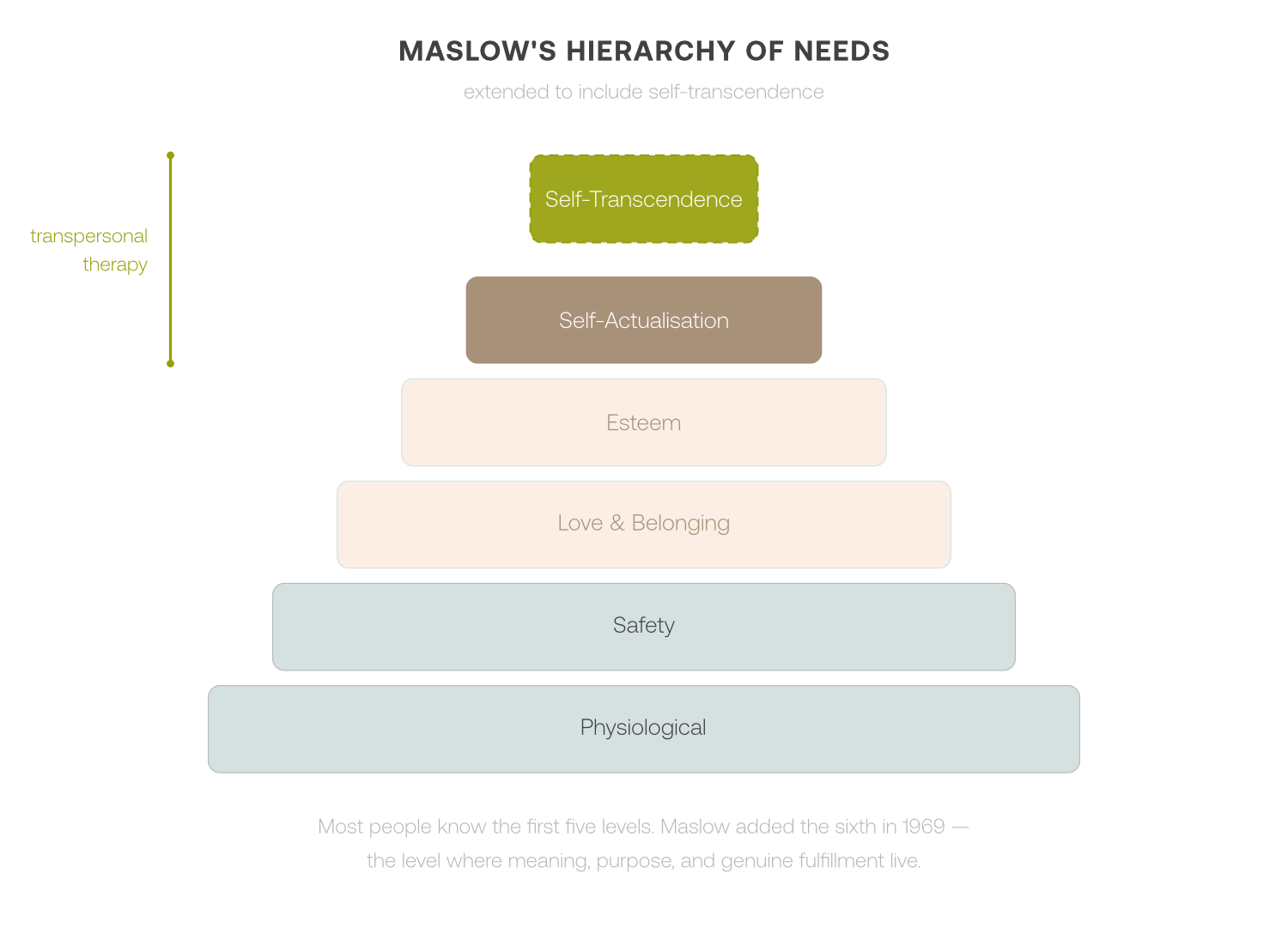
The roots of transpersonal therapy run through the work of Carl Jung, who understood that the psyche holds far more than personal biography. Abraham Maslow, known for his research on human development and his hierarchy of needs, eventually moved beyond self-actualisation toward what he called self-transcendence — recognising that the deepest human fulfillment involves connecting with something larger than the everyday personality. Stanislav Grof contributed pioneering work on expanded states of awareness — including holotropic breathwork — and their role in transpersonal healing. Together, these thinkers established transpersonal psychology as what Maslow described as a “fourth force” in the field — after psychoanalysis, behaviourism, and humanistic psychology.
More recently, Ken Wilber’s integral framework has mapped these developmental stages into a comprehensive model of human growth — what he calls the spectrum of consciousness — offering practitioners and those seeking depth work a clear orientation for where this work leads and what deeper levels of integration look like. Transpersonal theory continues to evolve, but its core insight remains: who you are extends beyond the boundaries of the ego, and genuine healing must account for that.
In practice, transpersonal therapy recognises that some of the most meaningful therapeutic work happens in naturally expanded states of awareness. These are states the body and mind enter on their own — alpha and theta brainwave states — when the conditions are right: when you feel safe, when the practitioner can hold the space with clarity, and when there’s enough time and trust for the deeper layers to surface. They allow access to material that ordinary conversation simply can’t reach. This is part of what gives transpersonal work its depth and its capacity to touch something that more structured approaches leave untouched.
The word “transpersonal” literally means “beyond the personal” — beyond the persona, the mask, the functional self you present to the world. Beyond the ego boundaries that define your everyday identity. That might sound abstract, but in lived experience it’s remarkably concrete. It’s the moment when someone who has spent decades defining themselves through achievement begins to sense that who they truly are runs far deeper than what they’ve built. It’s the recognition that lasting fulfillment, real meaning, genuine inner peace — these can rarely be found on the level of personality and cognitive knowledge alone.

How Transpersonal Therapy Differs from Other Therapeutic Approaches
If you’ve worked with other forms of therapy, you already know that different approaches focus on different layers of experience. Each has real value, and for many people the right modality at the right time makes an enormous difference.
Cognitive behavioural therapy works with thought patterns and learned behaviours. It’s effective at reducing symptoms — particularly anxiety, depression, and specific phobias — by helping you recognise and change the mental habits that maintain them. What it tends to address less is the deeper question of why those patterns formed in the first place, and what they may be expressing about your relationship to yourself and your life as a whole.
Psychodynamic and talk therapy goes deeper into the unconscious — childhood patterns, relational dynamics, the way early experience shapes how you connect with others and with yourself. This work can be profoundly important. Transpersonal therapy shares this interest in the unconscious, but extends the frame further. It includes the dimension of meaning, purpose, and the longing to integrate all of who you are — not only the parts shaped by biography, but also the parts that carry your deeper sense of direction and potential.
Somatic and body-based therapy recognises that the body holds experience — tension, trauma, emotion — and works to release and process what lives beneath conscious awareness. Transpersonal therapy often integrates somatic awareness, understanding the body as a gateway to deeper material. It places that body-level work within a larger frame of identity, meaning, and personal wholeness.
Humanistic therapy is the closest relative. Both value the whole person, both believe in your capacity for growth and self-actualisation. Transpersonal therapy extends this by engaging with the dimensions that Maslow himself eventually pointed toward: the deeper Self, the longing for integration, the parts of experience that go beyond self-improvement into genuine self-understanding.
A pattern that comes up often in practice: someone arrives having done years of good therapy. They’ve benefited genuinely — they understand their patterns, they’ve processed emotions, perhaps they’ve done bodywork too. And yet there’s a core layer that hasn’t been touched. The intellectual and emotional dimensions have been addressed, sometimes even the physical. But the level of the soul — of the deeper Self, the place where meaning lives — remains unexplored. Transpersonal therapy is designed to reach that level, carefully and with the right support.
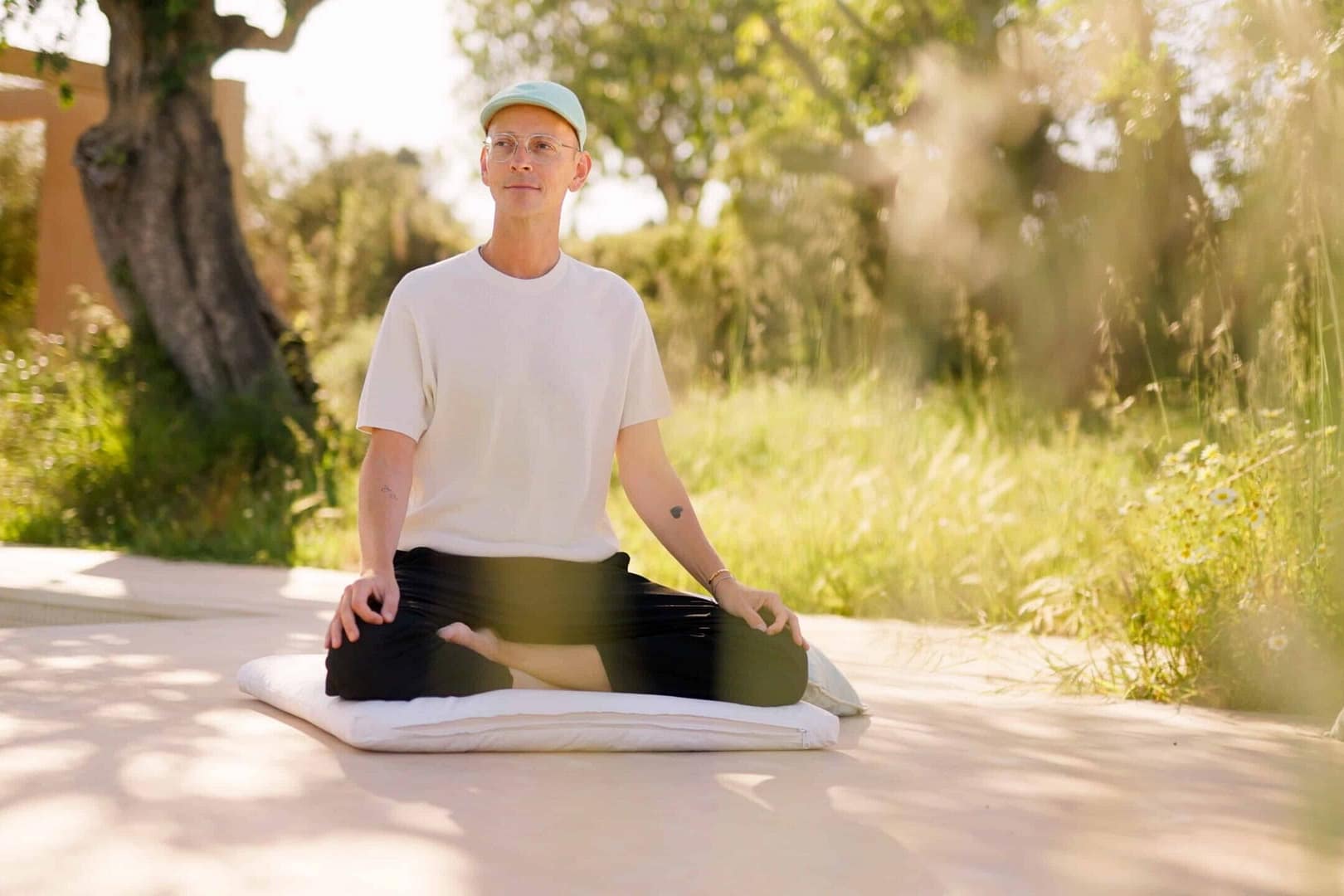
What Happens in Transpersonal Therapy
The most meaningful transpersonal work happens when the practitioner has the capacity to fully allow your psychological reality into the room. Whatever you experience — images, sensations, memories, emotions, or material that doesn’t fit familiar categories — is met as real. Not analysed from the outside. Not reduced to a diagnosis. Jung called this the phenomenological approach: if you experience it, it is your reality, and the work is to make the unconscious conscious.
This requires deep experience on the practitioner’s side. The therapist’s role is to hold the space with clarity and precision — to allow whatever surfaces without losing direction or structure. You are not left alone with overwhelming material, and you are not steered toward a predetermined outcome. The practitioner guides, offers frameworks when they’re useful, and knows when to simply be present while something unfolds.
A session begins with conversation, but a different quality of conversation. The therapist listens for what’s trying to emerge, not for what’s wrong. If you say “I feel lost,” a transpersonal therapist hears the lostness — and also pays attention to what deeper wisdom the lostness is guiding you to. The language you use matters. If you speak about longing for something you can’t name, that longing is taken seriously as a signal from a deeper intelligence within you.
As trust deepens and the therapeutic container stabilises, naturally expanded states of awareness can emerge within a transpersonal therapy session. These aren’t dramatic or unsettling — they’re what happens when your body-mind settles into a depth where insight becomes available in a different way. The practitioner works with whatever surfaces in that space. Breathwork, guided inner work, reflective dialogue, or somatic approaches may all play a role, depending on what the moment calls for and what you’re ready for. This embrace of and trust into the emerging psychodynamic material is the foundation for very powerful transformation.
Techniques you may encounter in transpersonal therapy include transpersonal regression therapy — careful, guided exploration of past experiences that shape deep patterns of current life experience — as well as breathwork, meditation, guided imagery, dreamwork, and body-aware dialogue. Transpersonal somatic therapy bridges the body and the psyche, recognising that the two are inseparable in deep work.
Integration is essential. The depth work needs to land in your daily life. This is where transpersonal therapy needs bridging into more practical, coaching-based approaches — helping you translate insight into decisions, new ways of relating, and a more grounded sense of who you are and how you want to live. The profound and the practical belong together. Without integration, even the deepest experience remains an isolated event rather than a genuine shift.
Who Is Transpersonal Therapy For?
Transpersonal therapy tends to find the people who need it — often at a turning point they didn’t plan for.
You may be in the second half of life, having achieved much of what you set out to achieve, and discovering that success didn’t answer the deep questions that lead to inner fulfillment. A pattern we see regularly: someone arrives in their fifties, having built an impressive external life — career, financial security, perhaps recognition in their field. And underneath all of it, there’s depression, anxiety, a sense of being drained and disconnected from themselves. They’ve spent decades focused on the outer structure and neglected the inner Self. Not out of carelessness, but because no one ever gave them a framework for tending to that dimension.
When someone like this begins doing transpersonal work, what often emerges first is the sheer weight of unprocessed material — the emotions, the grief, the questions about meaning that were set aside for years because there was always something more urgent to handle. The functional personality that carried them through decades begins to soften, and something more alive starts to surface. It’s often described as feeling like coming home — not to a place, but to themselves.
Transpersonal therapy is also for you if you’re navigating grief, an existential crisis, a major life transition, or a period where the familiar structures of identity no longer hold. If you’re asking questions about meaning, fulfillment, purpose — and sensing that the answers live somewhere beyond the level of thinking.
You don’t need to consider yourself spiritual. You don’t need a belief system or a meditation practice. What helps is a willingness to acknowledge that who you are runs deeper than your roles, your history, and your habits of mind — and a readiness to explore what lives in that depth.
Why Transpersonal Therapy Goes Deeper on a Retreat
Transpersonal work asks something of you that most therapeutic formats struggle to accommodate: it asks for continuity.
In weekly sessions, you may touch something genuinely deep — a layer of emotion, a memory, a moment of insight that changes how you see yourself. And then the hour ends. You gather yourself, walk back into your day, and by the time you reach home or the office, the ordinary self has reassembled. Most people describe this experience clearly: they could feel themselves approaching something important, and then the session was over. They had to “have it all together” again before they’d even left the building.
A private retreat setting — for many people, for the first time in their lives — removes that constraint entirely. There’s no commute. No inbox. No one else’s needs to manage. The space holds you, and the work can unfold in its own rhythm: depth in the morning, integration in the afternoon, rest and reflection in between.
For transpersonal work specifically, this matters enormously. The expanded states of awareness that allow access to deeper material need time and safety. They don’t arrive on a schedule, and they can’t be rushed into a fifty-minute window. On retreat, the body relaxes enough to open, the mind quiets enough to listen, and the therapeutic relationship has the continuity to support whatever emerges — through a full arc of exploration and integration, rather than fragments spread across weeks.
The holistic approach of a transformative retreat — where body-based practices, therapeutic depth, and restorative space work together — opens you at every level simultaneously. Body, mind, and the deeper Self can be addressed as one. What might take months in weekly sessions can reach a meaningful depth in days, because the process is never interrupted.
This is why people leave retreat work feeling fundamentally different — lighter, more alive, more themselves. The weight lifts because the work was given the space it needed to actually complete.

What to Look For — and What to Watch For
When considering transpersonal therapy, the practitioner matters as much as the modality. Look for someone with genuine clinical experience and depth of training — someone who can hold space for your deeper material with clarity and skill, and who can bridge between the profound and the practical. The therapeutic relationship is the foundation. Without trust, safety, and a sense of being truly met, the deeper work simply can’t happen.
What to watch for:
- Spectacular promises or language that sounds more like marketing than therapeutic practice
- Heavy reliance on ritual, mystical tools, new age claims or “secret knowledge” as the method
- Any suggestion that you can bypass the real inner work — the grief, the difficult truths, the discomfort — through a shortcut or a quick technique
The most meaningful transpersonal work is rigorous. That’s worth knowing in advance, because it’s also what makes it trustworthy. The depth is where genuine transformation lives, and there are no fast lanes to get there. When a practitioner is honest about that, it’s one of the clearest signs you’re in the right place.
Frequently Asked Questions About Transpersonal Therapy
Is transpersonal therapy evidence-based?
The evidence base for transpersonal therapy is growing steadily. Research on mindfulness-based interventions, breathwork, and psychedelic-assisted therapy — all of which share roots with transpersonal approaches — has produced strong clinical results. Studies on transpersonal psychotherapy specifically, including work with cancer patients, have shown measurable benefits for depression, anxiety, and post-traumatic stress. The field continues to build its formal research base, while many of the individual techniques it draws from are already well-supported.
Do I need to be spiritual to benefit from transpersonal therapy?
No. You don’t need a spiritual practice, a belief system, or any particular worldview. Transpersonal therapy works with your direct experience — the deeper dimensions of who you are, your sense of meaning, your longing for coherence — regardless of how you frame those experiences philosophically. What helps is openness: a willingness to explore aspects of yourself that go beyond your usual way of thinking. Many people find that the work touches something they might describe as a spiritual experience, even if they’d never used that language before.
What’s the difference between transpersonal therapy and transpersonal psychology?
Transpersonal psychology is the academic field — the theory, research, and frameworks developed by thinkers like Jung, Maslow, and Grof. Transpersonal therapy is the applied practice: working one-to-one with a practitioner who uses those principles to support your healing and growth. Think of it as the difference between studying architecture and actually building a house.
How is transpersonal therapy different from spiritual counselling?
Spiritual counselling typically works within a specific religious or spiritual tradition and may involve guidance rooted in particular teachings or practices. Transpersonal therapy draws on depth psychology, somatic awareness, and the broader human experience of meaning-making. It doesn’t belong to any tradition and doesn’t require you to hold any particular beliefs. The focus is on your lived experience and your own path toward integration and wholeness.
Can transpersonal therapy help with trauma?
Yes. Transpersonal approaches are particularly relevant for trauma work because they address the impact of traumatic experience across multiple dimensions — emotional, somatic, energetic and existential. When trauma disrupts your sense of meaning, identity, or safety in the world, an approach that works only at the cognitive or even the emotional level may not reach deeply enough. If you’re interested in how trauma healing works in a retreat setting, our guide to trauma healing retreats explores this in depth.
Finding Your Path
Transpersonal therapy is, at its core, about becoming more fully who you are. It takes the whole of your experience seriously — the feelings that make sense and the ones that don’t yet, the questions that have clear answers and the ones that require a different kind of listening.
If this resonates, you may want to explore what this work looks like within an immersive retreat setting designed for deep therapeutic work. The depth that transpersonal therapy offers becomes available in a different way when the container holds, when there’s time, and when you’re supported through the full arc of the process.
Whatever your next step, the fact that you’re asking these questions is itself a sign. Something in you already knows there’s more.
If you’d like to explore whether a private therapy retreat at Casa Sol might be the right fit, we start with a 30-minute conversation. No pressure — just an honest first meeting. Book a Discovery Call →
For a broader view of how different types of retreats support different kinds of inner work, our complete guide is a good place to start.
Exploring Your Options?
Choosing the right retreat is a meaningful decision.
Our honest guide covers what to look for, what to ask — and what most retreat websites won’t tell you.
11 practical things worth knowing before you decide.
And if what you’ve read here resonates, you’re welcome to explore what we offer — or simply have a conversation about what might fit.
Retreats for Men: A Guide to Depth, Healing & Real Change [2026]
This guide maps the full landscape of men's retreats, helps you understand the real differences between formats, and gives you a framework…
Transpersonal Therapy: What It Is and Why It Goes Deeper
In this guide, you'll learn what transpersonal therapy actually is, where it comes from, how it differs from more familiar approaches, what…
Trauma Retreats: Who They’re For and How They Work
This guide explores what trauma actually is, who trauma retreats serve, and how the process works — so you can sense and recognise whether…
Therapy Retreats: What to Expect, Who They’re For, and How to Choose Well
You've probably been in therapy before — or you've considered it seriously. Weekly sessions have their place, and for many people they're…
Types of Retreats: A Guide to Finding the One That’s Right for You
Most people who start looking at retreats aren't in deep crisis. They're functioning — seen from the outside, often functioning quite well.…

Trauma Retreats: Who They're For and How They Work
Trauma Retreats: Who They’re For and How They Work
Something is running in the background that has profound effects on your life. You’ve done inner work — maybe coaching or therapy, books and honest conversations with yourself — and yet there’s a layer that hasn’t moved. A tightness in the chest when certain topics surface. A pattern in relationships you can see with perfect clarity but somehow can’t change. A version of yourself that takes over under pressure and makes decisions the rest of you wouldn’t choose.
That layer has a name, though it may not be the one you expect. What you’re carrying is most likely unresolved trauma — and a trauma healing retreat is one of the most focused ways to work through it. This guide explores what trauma actually is, who trauma retreats serve, and how the process works — so you can sense and recognise whether a trauma retreat is a meaningful next step in your life right now.
Key Takeaways
- Trauma doesn’t require a dramatic event — even experiences that were dismissed or downplayed can reshape and limit your nervous system, self-image, and daily life in lasting ways.
- A trauma retreat weaves therapeutic depth with body-based practices in a concentrated, private setting — far more than compressed talk therapy.
- Trauma healing retreats serve people who sense that something unresolved and difficult is limiting them, whether or not they’ve ever used the word “trauma” to describe it.
- The immersive, multi-day format gives your nervous system the space to open gradually and process what weekly sessions rarely reach.
- Choosing the right trauma retreat comes down to practitioner experience, therapeutic depth, and honest aftercare.
What Trauma Actually Is — and Why It’s More Common Than You Think
The word “trauma” tends to evoke extremes — combat, catastrophic loss, severe abuse. Those experiences are real and significant. They also represent only one end of a much wider spectrum.
Understanding your own psychological health begins with a recognition that even minor life experiences — ones you’ve downplayed, or that others downplayed for you — can have deep and lasting effects on your physical, emotional, and mental well-being. Trauma, at its core, is any experience your nervous system couldn’t fully process at the time it happened. A dismissive parent. A moment of humiliation at school. Emotional neglect that was never named. Growing up in an environment where your feelings were treated as inconvenient.
None of these look dramatic from the outside. Each one can leave an imprint — a conclusion your younger self drew about who you are and what you deserve.
These conclusions settle below conscious awareness. “I’m not worthy.” “I’m alone.” “I need to be ashamed.” “Something is fundamentally wrong with me.” They become silent operating instructions, shaping how you relate to yourself and others, how you make decisions, what you believe is available to you. The weight is tremendous — and its most common expression is self-sabotage. You see what you want. Something keeps pulling you off course. Because it’s an unconscious reaction pattern, you might not even be fully aware of what’s going on.
When these deep-rooted patterns activate — when you get triggered — your nervous system responds before your conscious mind catches up. Fight, flight, freeze. These are survival responses, not character flaws. Your system learned to protect you, and it’s still running that programme. What shielded you at age six may be steering your decisions at forty-five.
You may even remember the original situations clearly. You may have thought them through many times. But the emotional charge remains fully active — the memory is understood, yet the body hasn’t let go. That gap between knowing and healing is precisely where trauma retreat work begins. When you work through those imprints and genuinely integrate the experience, the automatic responses lose their grip. Your relationship with yourself shifts. Your relationships with others can heal. A kind of inner freedom opens that thinking alone could never produce.
How Unresolved Trauma Shows Up in Daily Life
Unprocessed trauma rarely announces itself with a label. More often it arrives as stagnation — the quiet sense that you’re going through the motions without really moving forward. It can look like anxiety and depression, chronic indecisiveness, or difficulty sustaining closeness in relationships. It lives in the body too: persistent tension, disrupted sleep, a nervous system that never fully settles.
If you function well on the outside, the signs tend to be subtle. You might describe it as “something is off” rather than reaching for the word trauma. But when the same relational dynamics play out again, when success doesn’t bring the peace you expected, when your reactions don’t match the situation in front of you — those patterns are worth paying attention to.
Intergenerational Trauma: What You Carry That Isn’t Yours
Some of what you carry didn’t originate with your own experience. Intergenerational trauma describes the patterns, emotional responses, and belief systems passed down through family lines — often without anyone naming them. A parent shaped by scarcity may transmit anxiety around safety without ever describing their own childhood. A grandparent’s unprocessed grief can ripple forward as emotional unavailability that echoes across generations.
This shows up regularly in trauma retreat work. You begin to explore a pattern and realise it doesn’t entirely belong to you. The belief, the fear, the coping strategy — it was inherited. That recognition can be one of the most liberating moments in the healing process. The question shifts from “what’s wrong with me?” to “what have I been carrying that I can now set down?”
What Is a Trauma Retreat — and What It Isn’t
Without a reference point, most people imagine a trauma retreat as a compressed block of talk therapy — the same process as weekly sessions, just more hours. The real difference is how different methods and modalities weave together into a coherent, holistic experience.
A well-designed trauma healing retreat integrates therapeutic depth with body-based practices, nervous system regulation, and the kind of safe and supportive environment that allows your system to open gradually. The practitioner’s experience is central — the ability to facilitate profound depth while maintaining stable, conscious processing across physical, emotional, mental, and energetic levels. When that quality of trauma-informed care is present, genuine breakthroughs and lasting integration become possible.
A trauma retreat is also not a quick fix. Healing doesn’t conform to a convenient timeline, and no honest practitioner would suggest otherwise. Yet there is more healing and integration available in a short, concentrated period than most people would imagine — especially when setting, practitioner, and method work as a coherent whole.
What a trauma retreat is not: crisis intervention. Psychiatric care. A wellness spa with a therapy label. Residential rehabilitation. It’s a focused, intentional period of deep inner work — for people who are ready to face what has been held back, with skilled support alongside them.
The outcome isn’t that all problems dissolve. It’s that you regain sovereignty and agency. You navigate daily challenges from a grounded position rather than from reactivity or old survival patterns. For someone who has been living under the weight of unresolved trauma, that shift changes everything.

Who a Trauma Healing Retreat Is For
People who seek out this work tend to arrive from one of two directions.
The first: you’ve already done significant inner work. You may be quite conscious of your patterns — possibly carrying a diagnosis of PTSD or complex PTSD. You’ve been in therapy, perhaps for years, and you’ve made real progress. Yet something hasn’t shifted at the deepest level. The move beyond the trauma pattern into a fundamentally different way of being hasn’t happened. A trauma retreat offers the depth and continuity that weekly sessions couldn’t provide.
When very difficult things have been experienced, the traumatic situation itself won’t be erased. That’s not what healing means. What becomes possible is living with it more freely — and in many cases, arriving at a genuine sense of closure of the traumatic experience. The topics that bring people in this direction often include neglect, abusive relationships, violence, or the social, cultural, and economic hardships that imprint a distorted self-image — one that works like an invisible barrier to experiencing life more fully.
The second direction: you wouldn’t describe your experience as trauma at all. You might say “difficult childhood” or “complicated family” or “I’ve always been this way.” You carry deep wounds from growing up, or find yourself in relationships that are detrimental to your well-being, but the word “trauma” feels too strong for what you went through.
It isn’t the circumstance or intensity of the experience that makes something trauma. It’s the real-life effect — the inner conflict, hardship, and limitation that resulted from it. A single dismissive comment from a parent, repeated across years, can shape a nervous system just as powerfully as one overwhelming event. What matters is what it did to you, not how it would look from the outside. Often we downplay those experiences to not challenge those who should have been caring about us better. Traumatising experiences get normalised as we are afraid to fall out of the herd.
Childhood Trauma and Adult Patterns
Many patterns that bring people to trauma healing retreat work have roots in childhood — often not in what happened, but in what was missing. Emotional attunement that wasn’t there. Safety that was inconsistent. The experience of being truly seen as we are that never quite landed.
These early absences create inner templates. The child who learned that their needs were too much becomes the adult who cannot ask for help. The child praised only for achievement becomes the high-performer who cannot rest. This is where inner child work becomes relevant — not as an abstract concept, but as the process of meeting those younger parts of yourself with the understanding they never received. These patterns are wired into the nervous system, and they ask for more than insight to resolve. A trauma retreat creates the conditions for that deeper, embodied work.
How Trauma Retreats Work Differently from Weekly Therapy
If you’ve been exploring therapy formats, our comparison of therapy retreats and weekly therapy covers the structural differences in depth. When it comes to trauma work specifically, the format matters even more.
The intentional arrangement of sessions within a retreat, combined with the continuous safety of the container, allows you to go deeper and deeper into the process. In weekly therapy, you open something difficult in a session, then close it to re-enter your life — family, work, the needs of others. Your social persona reassembles. The next session often begins with rebuilding ground you’d already covered.
In a retreat, that cycle dissolves. Step by step, day by day, session by session, the process deepens and healing can genuinely unfold. This is less about intense confrontation and more like a symphony — opening, depth, stability, lightness, movement, integration, further deepening. Your nervous system receives the space to reveal what has been pushed down or held on pause for years, sometimes decades.
The concentrated, immersive format — closer to an intensive therapy retreat than to standard outpatient work — often produces the shift that makes genuine trauma healing possible. That observation comes from working with many retreat guests who spent years in standard therapy formats — making progress, yet never arriving at the integration that releases the pattern at its root. Weekly sessions have real value. And the depth that becomes accessible when you step fully out of your daily life, with nothing to perform for anyone, is qualitatively different.
Privacy adds another dimension. In a one-to-one setting, without group dynamics or comparison, your system can lower its protective layers on its own terms. The environment itself — distance from daily triggers, contact with nature, the simplicity of having no demands — becomes part of the therapeutic process.

What the Body Has to Do with Trauma Healing
Trauma lives in the body. Even when processing seems to happen on the level of the mind, the body carries what hasn’t been resolved. The mind-body connection in trauma work is not a metaphor — it’s the foundation. Psychological experience is processed through and with the body, not apart from it.
The body has a tremendous capacity to store tension and emotional pain. When release begins, the experience is often intensely physical — waves of heat or cold, areas of tension that suddenly soften, energy that was stuck beginning to move again. These sensations are not side effects. For a skilled practitioner, they are essential cues that guide the next step in the process. The body’s wisdom often reveals what the mind alone cannot see.
Working with holistic therapies like therapeutic yoga, bodywork, and energy practices such as Jin Shin Jyutsu supports somatic healing at a non-verbal, cellular depth. Mindfulness and meditation practices further support this process — creating the inner stillness that allows sensation and emotion to surface safely. As old patterns of holding, protecting, and suppressing begin to release, something visible happens. It shows in posture, in flexibility, and perhaps most strikingly in the face — as if a mask held in place for years finally gives way to the natural expression of the person underneath.
If the somatic dimension of trauma healing interests you, somatic therapy retreats take this further — a topic we explore in a dedicated article.
PTSD, Complex Trauma, and When a Retreat Can Help
PTSD is one of the most widely recognised trauma responses, but far from the only one. Complex trauma — the kind that doesn’t stem from a single event but from ongoing conditions like years of emotional neglect, a chronically unsafe home, or relationships that slowly eroded self-worth — often doesn’t fit neatly into diagnostic categories. Its effects on daily life are profound.
A trauma retreat can be deeply effective for both PTSD and complex trauma. Credible practitioners will also tell you it isn’t right for everyone at every stage. The work requires a specific kind of readiness: enough inner stability to engage with difficult material without being overwhelmed by it. This is a delicate balance — what the Germans call Fingerspitzengefühl, an intuitive sensitivity on the part of the practitioners.
Trauma work is deep, intense, and ultimately liberating. It asks for openness and a willingness to face what arises. It asks for experienced practitioners with the presence and credibility to hold a safe, honest space — one where your psychological system can trust enough to open.
When someone is too destabilised, too confused, or too easily overwhelmed, softer approaches come first: cognitive processing, art therapy, stabilisation work with a trusted therapist. This is intelligent preparation for further deeper work. Some people arrive at retreat work after months of foundational therapy. Others are ready immediately. It’s a case-by-case assessment, and any practitioner worth trusting will be straightforward with you about where you stand.
For those in acute psychiatric crisis or on heavy medication regimes, a retreat format may not yet be appropriate. That’s a question of timing and readiness, not a closed door.
What to Expect During a Trauma Healing Retreat
Every trauma retreat follows its own rhythm. The arc tends to be similar: arrival and settling, gradual deepening, core therapeutic work, integration, and a grounded close.
The first day centres on safety. You meet your practitioner, discuss your intentions and history, and adapt to the environment. Therapeutic work may begin gently — your nervous system needs to establish trust before it can open to deeper material. Rushing this important foundation undermines everything that follows.
Over the days that follow, the work deepens. Sessions alternate between conversation-based therapy, body-focused practices, deeper transformative therapeutic practices, and time for quiet integration — walks, rest, nature, journaling. The emotional landscape shifts: lightness after a heavy session, a surprising wave of grief on what seemed like a calm afternoon. These fluctuations are natural. They signal that your system is finally processing suppressed material.
The closing phase focuses on consolidation. What have you accessed? What has shifted? What practices will support you going forward? A well-structured trauma retreat doesn’t end on an emotional peak — it ends with your feet on the ground, with clarity about where you’ve been and where you’re heading.
Throughout, the practical environment matters. Nourishing food, contact with nature, a private space where nothing is required of you — these are not luxuries. They are conditions that allow your system to do its deepest work.
What Happens After a Trauma Retreat — Integration and What Comes Next
A good trauma retreat is designed so that you leave with a solid sense of closure after the intensive work. The heavy lifting has a landing. You feel different, and the difference is real.
Some vulnerability around the topics you worked through is natural in the weeks that follow. The recommendation is to move slowly back into daily life and continue integration practices — journaling, bodywork, integration sessions with a therapist when you are back home. In the best case, your retreat provider offers continued support: specifically designed practices and check-ins that help complete the process and build new, healthy routines long term.
Environments, family systems, and external circumstances don’t change because you’ve done deep inner work. The situations that were challenging before the retreat will likely still be there when you return. What changes is your relationship to them. A new self-image. A more mature way of meeting difficult emotional material and inner states. The ability to spot triggers early, define clear boundaries, and choose how you respond — building genuine resilience from the inside out.
That shift — from reacting to responding — may be the most meaningful outcome of trauma retreat work. It doesn’t make life effortless. It gives you sovereignty over how you meet what comes.

Frequently Asked Questions About Trauma Retreats
How long does trauma take to heal?
There is no universal timeline. Healing depends on the nature and depth of what you carry, the quality of support you receive, and your readiness for the process. Some people experience profound shifts in a single retreat. Others find that healing unfolds across months or years with different forms of support. What a concentrated trauma retreat can offer is a significant shift in a short period — often more than years of weekly sessions produce — while emotional healing and integration continue well beyond the retreat itself.
What’s the difference between a trauma retreat and residential treatment?
Residential treatment typically involves extended stays of 28 days or more in a clinical environment with structured daily programming, designed for people who need stabilisation, medical support, or round-the-clock care. A trauma healing retreat is shorter, more intensive, and designed for people with enough stability to engage in deep therapeutic work without clinical oversight. Both serve important purposes — the right choice depends entirely on where you are in your process.
Can a trauma retreat help with PTSD?
Yes. Trauma retreats that incorporate evidence-based therapeutic modalities such as EMDR, somatic therapy, and transpersonal approaches can be very effective for PTSD. The concentrated format allows for the kind of sustained processing that PTSD often requires. If you’re currently in crisis or experiencing severe dissociation, a practitioner may recommend stabilisation work before intensive retreat-level processing.
Do I need a diagnosis to attend a trauma healing retreat?
No. Many people who benefit deeply from trauma retreat work have never received a formal diagnosis. If you recognise patterns of reactivity, self-limitation, or emotional pain rooted in past experiences, that recognition is enough. A thorough intake conversation with your practitioner will help determine whether a trauma retreat fits where you are right now.
What types of therapy are used at trauma retreats?
This varies between providers. Common approaches include transpersonal therapy, somatic therapy, EMDR, breathwork, therapeutic yoga, and various forms of bodywork. The most effective retreats don’t rely on a single modality — they combine approaches based on what you specifically need, adapting as the work unfolds. When evaluating a trauma retreat, ask about the practitioner’s training and how they integrate different methods. The coherence of the approach matters more than the length of the modality list.
How to Choose the Right Trauma Retreat
Look for practitioners who combine genuine therapeutic depth with body-based approaches and a clear intake process. A qualified provider will want to understand your history before you arrive — not only to plan the work, but to honestly assess whether their offering is the right fit for you right now. That willingness to say “not yet” or “not here” is itself a sign of quality. One of the most important guidelines is how you experience the practitioners in the pre-retreat assessment — do you feel genuinely seen and your experiences acknowledged? Are you handled as a label like “you have depression” or “you have anxiety,” or are you treated like a full human being? Your gut instinct will give you clues about the trust you can build with the people guiding you.
What to watch for:
- Vague credentials or reluctance to discuss training and experience
- No intake conversation before booking
- One-size-fits-all programmes with no adaptation to the individual
- Grand promises of complete transformation with no mention of integration or aftercare
- Formats that rely entirely on group work with no option for private, one-to-one sessions
If you sense that something unresolved has been quietly shaping your life — whether you call it trauma, old patterns, or simply the weight of experiences you never fully processed — the right retreat can create a shift that years of other approaches haven’t reached. The work is deep, and it asks something of you. What it gives back is yours to keep.
If what you’ve read here resonates, you can explore how we approach trauma-informed retreat work at Casa Sol, or schedule a discovery call to talk through whether this kind of experience fits where you are right now.
This article is part of our guide to types of retreats — a resource for finding the retreat approach that matches what you’re actually looking for.
We created the Honest Guide to Choosing a Retreat to help you navigate this decision with clarity. It covers what to ask, what to look for, and how to trust your own judgement in the process.
Exploring Your Options?
Choosing the right retreat is a meaningful decision.
Our honest guide covers what to look for, what to ask — and what most retreat websites won’t tell you.
11 practical things worth knowing before you decide.
And if what you’ve read here resonates, you’re welcome to explore what we offer — or simply have a conversation about what might fit.
Retreats for Men: A Guide to Depth, Healing & Real Change [2026]
This guide maps the full landscape of men's retreats, helps you understand the real differences between formats, and gives you a framework…
Transpersonal Therapy: What It Is and Why It Goes Deeper
In this guide, you'll learn what transpersonal therapy actually is, where it comes from, how it differs from more familiar approaches, what…
Trauma Retreats: Who They’re For and How They Work
This guide explores what trauma actually is, who trauma retreats serve, and how the process works — so you can sense and recognise whether…
Therapy Retreats: What to Expect, Who They’re For, and How to Choose Well
You've probably been in therapy before — or you've considered it seriously. Weekly sessions have their place, and for many people they're…
Types of Retreats: A Guide to Finding the One That’s Right for You
Most people who start looking at retreats aren't in deep crisis. They're functioning — seen from the outside, often functioning quite well.…
